This is default featured slide 1 title

Go to Blogger edit html and find these sentences.Now replace these sentences with your own descriptions.

This is default featured slide 2 title

Go to Blogger edit html and find these sentences.Now replace these sentences with your own descriptions.

This is default featured slide 3 title

Go to Blogger edit html and find these sentences.Now replace these sentences with your own descriptions.

This is default featured slide 4 title

Go to Blogger edit html and find these sentences.Now replace these sentences with your own descriptions.

This is default featured slide 5 title

Go to Blogger edit html and find these sentences.Now replace these sentences with your own descriptions.

Wednesday, August 8, 2012

Pic: Radar Attenuation


I took this picture on Sunday afternoon while descending on the arrival to Ronald Reagan Washington National Airport.  In the picture, I'm on an ATC assigned vector for spacing with the aircraft ahead.

When using airborne radar, attenuation is a term regularly used to describe what you see here.  The green and yellow return standing alone on the left side of the screen does not appear to be especially large or dangerous.  But it is attenuating and the radar screen tells me nothing about what lies behind.  By tilting the radar beam down toward the ground, I was able to "paint" the ground at about 50 miles in front of the aircraft.  The green, yellow and red arc of color in the picture is the ground, not weather.  However, as you can see, the ground is not painting behind the storm.  There was enough moisture in this storm that my radar was not able to penetrate through the storm and paint what was on the other side.  There might be nothing there at all...or a level 5 thunderstorm might be lying in wait.

In my case, we never went anywhere near the storm.  But if I had been assigned a 030 heading, I would not have accepted the turn...at least not for long.

Monday, August 6, 2012

Pic: Long Flight to DCA


These two pictures were taken yesterday as my day was starting to improve. I was scheduled to fly 7.5 hours and ended the day with well over 9 hours added to my logbook. Weather in the northeast was the story of the day.

The first pic was taken while waiting our turn for takeoff from runway 19 at DCA. I prefer to land south and takeoff to the north, but didn't get to do either yesterday. We landed north, then the wind shifted before takeoff and we departed south...bummer. The view and the challenge of staying over the river north of the airport is a lot of fun.

I took the second pic while climbing through the clouds on my way back to DFW. The view and the sensation of climbing through the tops of the clouds will always be one of my very favorite things. So beautiful!

Monday, July 30, 2012

Oshkosh - AirVenture 2012

I was lucky enough to attend AirVenture 2012 at Oshkosh, Wisconsin this year.  I last attended Oshkosh in 1992 when I flew in with a student in a rented Bonanza F-33.  We slept under the wing that year and felt as though we had died and gone to aviation heaven.  This year, I was honored with the company of a life-long hero.  A man I've looked up to for many years.  He is a U.S. Army Vietnam Vet, a retired Delta Air Lines Captains with a 32 year airline career behind him, and the best father I know.  Below are a few pictures of what caught our attention.  

Glacier Girl, a beautiful P-38 lost in 1942, recovered, restored and on display at AirVenture 2012.


Curtis C-46  "Tinker Belle" - We got to see this beauty on display and in flight.


This gorgeous little Stinson with a commonly seen message..."Please look but do not Touch"


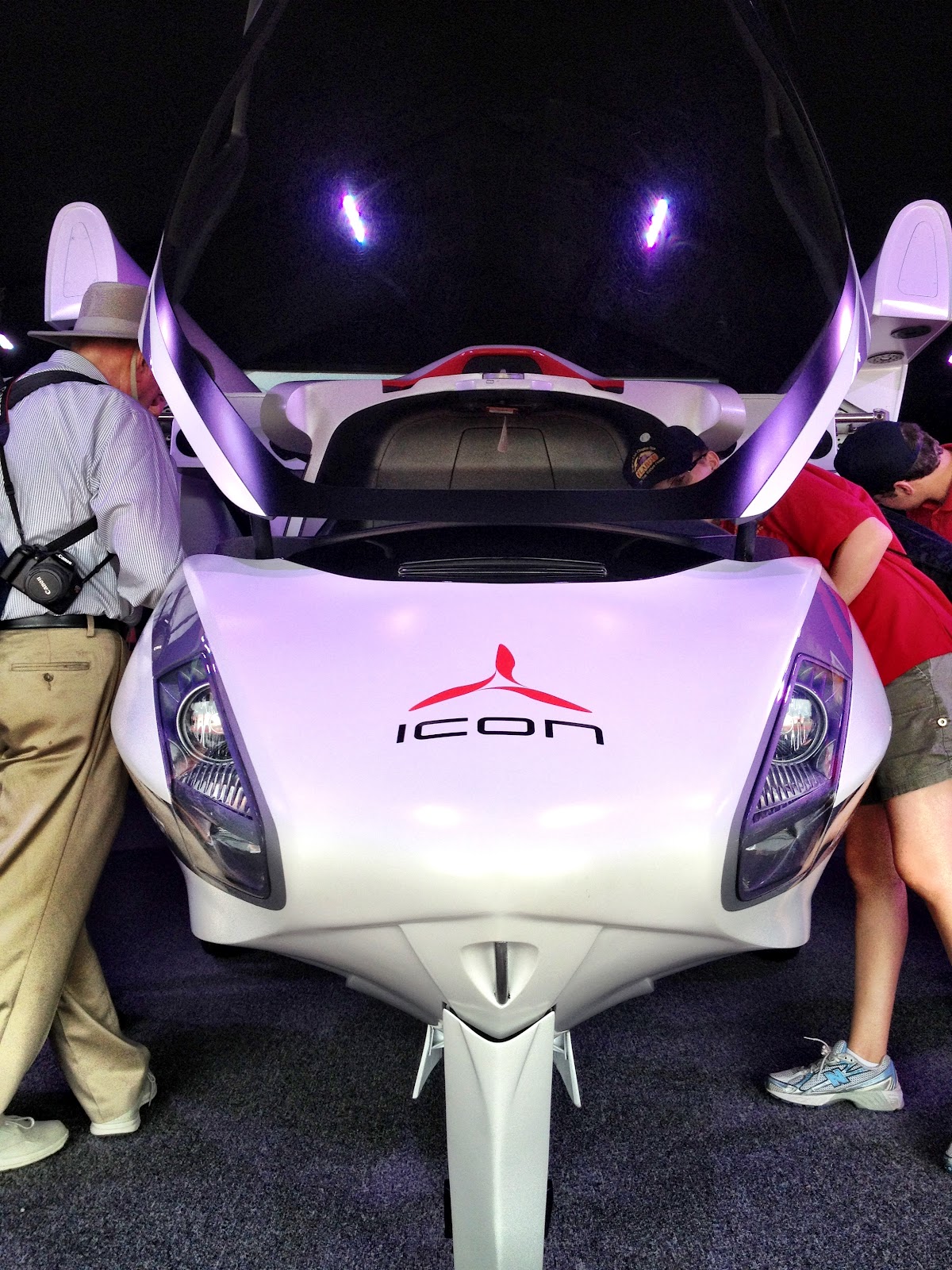
Icon A5 ...an impressive display that definitely caught my attention.  The inside of this tent looked like something straight out of Hollywood.  The Icon has a car-like look to it inside and out.  I would love to have one of these!  Especially after watching the video.


This A-36 Bonanza flew in from Cascavel, Brazil.  A short 34 hour flight.  The picture below was propped up against the nose gear and shows their plotted course. 


A new and inventive use for a chip clip?  


Orbis Flying Eye Hospital.  This was an eye opening experience...please excuse the pun.  I am told that FedEx manages and maintains the aircraft as part of its own fleet and that FedEx and United supply the pilots.  Click the link to read more, but I found this to be a donation worthy organization.  Check it out.


One of my favorite little airplanes, the  Piper J-3 Cub.  I got my tail wheel sign-off in one of these after being told by my father that I couldn't be a real pilot without tail wheel experience.  I couldn't agree more!


This is a picture of my awesome Dad in front of an  OV-1 Mohawk similar to the one he flew in the Vietnam War.  


Wednesday, June 20, 2012

Only in Arkansas


Take a close look at the picture to the left.  Notice anything odd?  No?  It’s there…keep reading.

I was the Captain of an EMB-120 Brasilia in November 1998, the month KXNA, Northwest Arkansas Regional Airport opened to the public.  Piloting a flight from Dallas, Ft. Worth scheduled to arrive well after dark, I noticed a NOTAM (Notice to Airman) that indicated the airport beacon would not be visible when approaching the airport from the southwest.  A lighted, land (as opposed to water) airport beacon is supposed to flash a constant white then green pattern at night or when the airport is experiencing poor weather conditions.  When flying at night in visual flight conditions, the beacon is most commonly used by pilots to identify the location of an airport.

Now familiar with the NOTAM, I was aware that the beacon would not be visible to me as I approached this unfamiliar airport at night for the first time.  Finding the airport…quite literally located out in the middle of nowhere…turned out to be a simple task, but the reason behind the NOTAM made me laugh back then and as I taxied past the XNA control tower earlier this week, I couldn’t help but laugh as I noticed the condition still exists today.

I queried the tower controller about this and got the same answer I got back in 1998, so I can only assume it to be true.  The airport beacon is often located on top of the control tower at small airports or at a significant distance from the control tower at some larger airports.  At KXNA, the beacon is located on a pole…wait for it…right next to the control tower and at the exact same height as the tower controllers.  So at night, or anytime the beacon is in use, the light from the beacon shines directly into the control tower, blinding the controllers as they attempt to perform their duties.  

“Only in Arkansas” the tower controller explained.  His words, not mine.

Clearly this was an unacceptable situation, so let me pose the same question to you that must have been asked of those in charge back then.  What should be done to rectify this design defect?  Move the beacon to another location on the airport.  Put the beacon on top of the control tower.  Put the beacon on a taller pole.  All sound like reasonable solutions to me.  Their solution?  Put a shroud around the beacon to keep it from shining into the control tower.  In their defense, this solution did indeed solve the problem at hand, but it also created the issue that remains today.  The beacon is not visible to pilots arriving from the southwest. 

“Only in Arkansas” the tower controller explained.  His words, not mine.

Tuesday, April 24, 2012

Downsizing


The plight of the average employee at American Airlines over the past ten plus years has been relatively unpleasant, and the bankruptcy process has, to no one’s surprise, failed to yield improvement. Today, even before the pay cuts I know are coming, I find myself unable to afford the house that was easily within my budget 10 years ago.  I’ve decided to downsize my finances and move into a smaller home, a process that has been all consuming during the past month.

Many have forgotten that the employees of this once great airline took huge pay cuts back in 2003 to avoid the very situation in which we are now embroiled. My personal contribution to the "keep American out of bankruptcy" fund included a 23% pay cut on top of a reduction in benefits and a displacement out of my home base for a period of five years. We took those cuts at a time when most of the other carriers were working under fresh new contracts that already put their salaries above ours, so the pay-cuts were especially deep and afforded the company a significant cost advantage over the competition. "Shared pain for shared gain" was the catch phrase we kept hearing from management, but 10 years later those managing the airline are the only ones who have gained financially as the airline has faltered under their leadership. 

Yesterday, as the airline’s legal team was in court arguing to have our contract thrown out the window, I was at my attorney’s office closing on the sale of my house.  As poor as the real estate market is in the US, I have been fortunate. A friend of a friend heard we were considering a move and asked to see the house. We were able to come to terms without the assistance of a realtor, saving me a significant chunk of change.

Moving into a significantly smaller home is never fun and the process of packing up and getting rid of everything that wouldn't fit was a time consuming and mentally exhausting experience.  While my wife and children have been exceptionally supportive, I know the move is hard them.

So while it's been an exciting month, I haven't had time to share my experiences with you. In the last 30 days I landed in El Paso, Texas in winds gusting to almost 50 knots with 1/2 mile visibility in blowing dust. I was lucky to be stuck in a hotel room the day tornadoes tore through the Dallas area...$3500 in damage to my car. The following week I circled west of the Dallas, Ft. Worth area for an hour before thunderstorms forced a divert for fuel and topped of the month with two significant mechanical issues...all stories for another time.

So yes, it's been an exciting month at home and at work. A month now topped off with rumors of a merger between American and US Airways. I would define my position as cautiously optimistic, but find myself on the fence.  The rumors of a merger between the two are nothing new, but they are now fueled with the knowledge that the three major unions at American are not only behind the idea but have successfully agreed to a tentative contract with the management of US Airways.  This is a major accomplishment given almost zero progress in contract negotiations with AMR during the past five years. Not to mention that while AMR is going forward with plans to impose draconian contracts on its labor groups, the US Airways management team is promising pay raises and job protections.

While this is all a significant improvement on what AMR has planned, I’m still unable to throw complete support behind the idea of a merger. There are many reasons for this, but my primary source of concern is simple history. US Airways wants, and arguably needs, American Airlines.  They have attempted and failed to merge with both Delta and United and are convinced that they need a partner to survive long term.  AMR is the last ugly girl at the dance and US Airways is tired of standing with their backs against the wall watching everyone else enjoy the party. I'm convinced they will say and promise whatever is necessary to gain the trust and cooperation of the labor groups at American. This is a serious concern that was clearly demonstrated when American merged with TWA in 2001.

I mentioned before that I was displaced to another base in 2003 after our first near miss with bankruptcy. My displacement resulted in 5 years of commuting to St. Louis, Missouri to fly with the former TWA pilots.  I had a love hate relationship with this pilot group.  They were just another group of pilots shaped by different circumstances than my own…both competent and skilled aviators.  But I also found them to be generally ticked-off about life and the impact the TWA/AA merger had on their careers.  Unfortunately I was often the target of their frustrations.

The merger agreement between the two airlines guaranteed that all Captain positions in St Louis, regardless of seniority, would be flown by former TWA pilots.  So during my five years in STL, I flew exclusively with former TWA pilots and often flew with Captains who were far below me on the American Airlines seniority list.  If I was successful in keeping the subject of conversation off the merger all was good...but I was rarely able to avoid the subject.  Once the subject of conversation veered toward the topic of the merger all bets were off.  I often endured angry tirades and long trips to the "soap box."  I didn't agree with much that was said but didn't feel the cockpit was the right place to get into an all-out argument, so I often kept my opinions to myself.

One thing I often heard from the TWA pilots stuck with me then and remains on my mind now. When the merger between American and TWA was announced, the employees of TWA rejoiced. They thought they had been saved. American wanted TWA and made promises to the employees…many of which they did not keep.  Not unlike the promises of pay raises and job protections that I'm hearing now. The TWA employees didn't fare so well in the years after 9/11 and I'm not sure how the employees of American Airlines will fare when the dust settles on this merger…assuming of course that it occurs at all.

It is what it is and only time will tell. The one thing that I know for sure is that I am simply along for the ride. Hopefully it will be a smooth one...but I wouldn't bet on it.


Tuesday, March 20, 2012

Delta Pilot Puts Uniform Up For Sale at Ebay

As the story goes, ebay pulled a listing in 2005 that a Delta Air Lines Captain had placed on the auction site. Up for sale? Captain Wendall Lewis's Captain's uniform. After Lewis saw his monthly pension of $6500 slashed by 73%, he decided to make a statement.  I post this now as my employer explores the depths of bankruptcy.  Don't get me wrong...I love my job and I'm thrilled and proud to wear my uniform every day, but I find it especially easy to relate to the statement made by this long time airline  veteran.  True or not...these stories often are not...the sentiment is an accurate representation of what many of us experience after a life-long airline career.

And here was his statement:

AUTHENTIC Delta Air Lines Captain Pilot Uniform This uniform was worn by a dedicated Delta Pilot for many years. Now retired and robbed of part, or all, of promised pension, uniform is now offered for sale to supplement income. Suit is worn and empty but filled with memories and honor. Suit has been across many miles and many experiences. Suit was once filled with pride and service getting thousands of passengers to their destination safely. Suit has been through rain, snow, ice, and wind without a single tear or scratch. Suit once controlled multi-million dollar assets, flown throughout the world, with billions of dollars of liability to the company. Suit has never cost company one (1) cent in accident or injury.

Although the suit is worn and has been discarded by the company, it can be yours. Suit is clean but used. Coat may be soiled from hydraulic fluid or grease as plane was inspected. Shirt may be soiled from mad dashes through the airport in a rush to the next plane in an effort to get back on schedule. Tie may have stains from fast food meals that were hurriedly eaten while at the controls.

Tie comes with your choice of pins, Air Line Pilots Association, Air Force, or Airplane. Pants may show signs of wear from may hours spent strapped into a seat, hip shows some signs of wear from firearm used to protect you and your passengers from harm. Shoes are shiny but worn. Suit comes with choice of Old Delta or New Delta emblems. Many prefer the Old Delta.

Suit is thought by many to have APHRODISIAC qualities, although this cannot be confirmed or denied.

BEWARE putting on this suit can have adverse effects on your life. It can cause you to miss your childrens' birth. It can cause you to miss holiday reunions, family times, and weekends. You may miss your Daughter's prom and your Son's graduation. Your family may think Christmas is not always on December 25th. Your wife will have to learn to be a single parent when you are gone for days. The suit can cause you to miss entire nights of sleep or get up at 3 AM to meet your next schedule. Your neighbors may be jealous of you and think you do not deserve to wear the uniform or be compensated for your work.

Originally suit required a four year college degree and an internship of 5-10 years in the military, and another 10-15 years for the fourth stripe. Suit comes with a promise of a pension if you provide years of dedication and service. THE PROMISE MAY BE AS EMPTY AS THE SUIT. Now it can be had for the highest bid. Good Luck bidding.


Thursday, March 8, 2012

The Strange and Difficult to Find MD80 Standby Compass

MD80 Standby Compass
Have you ever been in the cockpit of an MD80 series aircraft?  If you have, then you probably weren’t able get over the scrambled and chaotic design of the cockpit long enough to notice that something important was missing…the standby compass. 

I learned to fly in a 1980’s era Cessna 152 with a compass located in clear view in the center of the instrument panel.  The compass had to be checked against a standby “wet” compass and manually corrected by the pilot every few minutes.  If the pilot forgot to make the necessary corrections, then the compass would develop an error over time that would eventually lead the aircraft off course.  Most modern aircraft are equipped with a slaved compass system that continually and automatically updates and corrects the heading information displayed on the cockpit instrument panel, removing the need to continually check the accuracy of the compass system.  A standby compass is still required equipment and must, at a minimum, be checked before each flight and would be used in the event of a failure of the slaved compass system.

The cockpit picture below is that of a Boeing 757-200.  The standby compass is prominently and conveniently located on top of the center window post.  In the event of a failure of the compass system on this aircraft the pilots would be able to easily and clearly view the compass.  Except for the light within its casing, the standby compass needs no electrical power to operate and is functional during a complete loss of electrical power.

Boeing 757-200 Cockpit


The cockpit picture below is that of a McDonnell Douglas MD83.  Now that I’ve mentioned it, you might notice the absence of a standby compass.  Clearly this aircraft does not have a center window post, but it seems logical to me that the compass could have been placed above the post nearest the Captain.  If that wouldn't work, I could come up with at least two or three other options...in the ceiling behind the First Officer would not be one of them, but that's exactly where it is.

McDonnell Douglas MD83 Cockpit


In order to view the standby compass on this aircraft, the pilot must first flip up one of two mirrors on top of the instrument panel…one for the Captain and one for the First Officer.  No, the mirrors are not for checking the condition of your hair, but they are probably used more often for grooming tasks than for checking the compass.

After flipping up the mirror, the pilot must position the mirror in just the right position so that he can see a second mirror in the ceiling in order to view the compass.  The second mirror makes it so that the compass is not viewed backward as it would if viewed through only one mirror.  There’s even a light switch on the overhead panel that turns on a small light to illuminate the face of the compass. 


The video below shows the procedure in full.  After viewing the pictures and video maybe you will have the same thought that I’ve had for years…I sincerely hope I never have to use it on a dark and stormy night.