This is default featured slide 1 title

Go to Blogger edit html and find these sentences.Now replace these sentences with your own descriptions.

This is default featured slide 2 title

Go to Blogger edit html and find these sentences.Now replace these sentences with your own descriptions.

This is default featured slide 3 title

Go to Blogger edit html and find these sentences.Now replace these sentences with your own descriptions.

This is default featured slide 4 title

Go to Blogger edit html and find these sentences.Now replace these sentences with your own descriptions.

This is default featured slide 5 title

Go to Blogger edit html and find these sentences.Now replace these sentences with your own descriptions.

Saturday, August 18, 2012

Pic: Thunderstorms in the Morning


I know I've said his before, but the view is truly one of the best parts of my job.  I took this picture about thirty minutes into a flight from DFW to Washington Dulles earlier this week. I'm always a little surprised to see such a large storm this early in the morning. We departed DFW around 8am

Tuesday, August 14, 2012

Single Engine


Most of my flying during the past 18 years has taken place in and out of the same airport...an airport with which I am now quite familiar.  Like anything else, familiarity and routine can be both a positive and a negative thing.  On the positive side, it helps a pilot predict what is coming next and highlights unusual clearances, mistakes and anything else that might be out of the norm.  For instance, the normal climb out of DFW goes something like this…the initial clearance for jet aircraft is a climb to 10,000.  Typically, the first departure controller will clear you directly to 17,000.  The first center controller issues a clearance to FL230 and the first high altitude controller will issue a clearance to your filed cruise altitude, usually somewhere in the mid-thirties.

If you're familiar with what's normal, then you know that an initial clearance to something less than 10,000 is a good indication that there's traffic in the departure corridor that isn't usually there.  The absence of a clearance to 17,000 indicates conflicting traffic on the arrival.  A clearance to something less than FL230 might indicate that you are following slower traffic which would require a level off to avoid separation issues.  Pilots commonly use the term S.A...situational awareness.  S.A. is knowing what is happening around you at all times.  Not just with your flight, but with anyone around you.  We're all sharing the same taxiways, runways and airspace, and knowing and paying attention to what everyone else is doing only adds to the level of safety.  

Another byproduct of familiarity and routine is that it helps a pilot remember unusual events.  Many of the details in the story I’m about to share are seared into my memory more in relation to their departure from the norm, than anything else. 

The Captain was working the radios and I was at the controls as we took off from runway 18L on our way to Mexico for what was supposed to be a simple turn-around.  We had a full load of passengers and a heavy load of fuel in anticipation of poor weather at our destination, so the aircraft was well above maximum landing weight as we took to the air.  Our initial clearance altitude was 10,000, the first departure controller cleared us straight to 17,000, the first en-route controller cleared us to FL230 and the high altitude controller immediately cleared us to our cruise altitude.  So far so good.

As we passed FL230 we got a call from the First Class Flight Attendant who explained that she had our meals ready.  Yes, we get fed at meal time in the cockpit, but we usually get fed after the meal service is complete in the cabin.  Crew meals are a contractually negotiated perk that we have managed to hold onto over the years.  They’re a little like eating the same thing every day at a restaurant you don’t particularly like, but the food is free and pilots are cheap.

At any rate, the unusual timing of the cabin to cockpit chime highlighted the moment and the altitude in my mind.  As the Captain got out of his seat and stepped back to the cockpit door, the amber “Caution” light illuminated on the glare shield in front of me.  This light is designed to catch the pilot’s attention and direct him to an abnormal condition with the aircraft.  The overhead panel is a sea of lights, buttons and switches, but situated above the windshield and below the overhead panel is an annunciator panel.  Usually blank at this stage of the flight, the OIL STRAINER CLOGGING light stood out like a sore thumb.

"Master Caution" and "Master Warning" lights in the upper right hand corner.
MD80 Annunciator Panel as it normally looks during flight...dark, no lights
This is an issue I've handled before…on more than one occasion actually…but never in the real airplane.  It’s come up a few times in the simulator on a LOFT (Line Oriented Flight Training), something we do every nine months to stay current.  This time it was real and although the first thing we did was consult the emergency checklist, I knew what it said to do.

We were in communication with Houston Center at the time and the Captain requested a level off at FL240 because he too knew what was coming.  The Captain read the checklist as I performed the procedure.  After turning the auto throttle off, I added pressure to the left rudder pedal as I pulled the right engine to idle thrust.  I held pressure on the rudder instead of adding trim because I knew we would be starting down in a few moments and would have both engines at idle, negating the need for trim.

The warning light remained illuminated, but all other engine parameters appeared normal…oil temperature, pressure and quantity normal…EGT normal…N1 and N2 normal.  We were not required to shut down the engine.  It's much better to leave an engine running at idle if at all possible.  At idle, the engine is not providing any thrust, but it is providing air and electricity and is standing by to produce thrust if absolutely necessary.

I have declared an emergency on numerous occasions in my 25 year flying career and have always received prompt and helpful service from ATC.  Today would be no different.  I pushed the throttle up on the good engine in an attempt to control speed and asked the Captain to request a lower altitude.  Given the heat of summer and our heavier than normal weight, we weren't going to be able to maintain FL240.  The Captain declared an emergency and requested an immediate descent and a turn back toward the airport.  We were cleared to descend at our discretion to FL180, an altitude we could maintain on one engine, and were cleared directly to the airport.  We were now headed the wrong way on a heavily traveled departure corridor from one of the busiest airports in the nation, but ATC would clear the path for a straight in arrival with no delays.

 “Say souls on board and fuel remaining”

One of my jobs as the First Officer is to review the weight and balance data that the company sends us after we leave the gate.  This data must be received, reviewed and verified as correct before we can legally takeoff.  The closeout comes in the form of a short printout in the cockpit with all the information we need to verify the weight and balance of the aircraft.  Part of my personal routine is to write the flight number, draw a line from our planned flap setting to the stabilizer trim setting and make note of the number of souls on board in large enough print to be seen by old eyes…mine and the Captains.  (Pictured below is the closeout from another flight).  Souls on board and fuel remaining are typically the first two things ATC wants to know after a pilot declares an emergency.


“145 souls on board, three hours fifteen minutes fuel remaining”

After completing the checklists, the Captain was very busy keeping the Flight Attendants in the loop, making PA announcements to concerned passengers and coordinating our arrival back at the airport.  He delegated flying the airplane and working the radios to me. It was at this point that I remember making a conscious decision to make the arrival as normal as possible.  This goes back to the concept that know what is normal will highlight things that are not.  I wanted this arrival to look as normal as possible to help me identify anything else that wasn't.

As we descended with both engines at idle power, there was no differential thrust so the airplane flew normally.  I planned to pass abeam the departure end of the runway at 8,000 feet so I could make a power off descent to the final approach course.  We called the airport in sight and were cleared for a visual approach to runway 18R.  We could have had any runway we wanted, but 18R was the normal runway, so we stuck with normal.  We started our turn from the downwind leg back toward the airport as we passed through 5,000 feet and I didn't have to add power until we were almost over the final approach fix.

I slowed the aircraft and configured for landing as I would for any other flight with the exception of the flap setting.  We are required to use 28 degrees of flaps instead of the normal 40 degrees when landing single engine to help with climb performance in the unlikely event of a single engine go-around.  Less flaps...less drag...all good when operating on one engine.

At about 1,200 feet above touch down, I increased the power one last time on the good engine and stabilized our approach speed.  I'm not embarrassed to admit that the last 1,000 feet of the approach got my blood pressure up just a hair.  This was my first single engine landing out of the simulator.  We were over the maximum landing weight for the aircraft by almost 10,000 pounds and flying on one engine.  The approach needed to be perfect and in order to prevent damage to the aircraft, the touchdown needed to be smoother than normal.

I set the main gear smoothly onto the runway, lowered the nose until the wheel touched and raised the reverse thrust lever on the good engine as I applied the brakes.  We slowed to taxi speed on the runway and leisurely took the last high speed turnoff from the runway where the “safety vehicles” were waiting for our arrival.

 “Safety vehicles”

I may be letting the "cat out of the bag" here, but when making PA announcements to the passengers, there are many words we generally avoid…thunderstorm, tornado, wind-shear, emergency, engine failure, fire…just to name a few.  In this case, the words “fire truck” could strike fear into an otherwise calm and collected passenger.   Imagine if you will, a first time flyer sitting at the over-wing exit. He read the safety card in the seat back in front of him, so he's fully qualified, right?  After landing, the aircraft is surrounded by fire trucks with lights ablaze and a hand full of guys wearing full fire gear jump out and surround the jet. It isn't at all inconceivable that this guy might panic, pop the emergency exit and evacuate.  What a mess!  We want the passengers to be informed and we want them to know what is going to happen next, but certain words just cloud the issue.  We avoided stressful words and warned everyone ahead of time about the "safety vehicles."  No worries...please remain seated.

We stopped the aircraft on the taxiway just clear of the runway and shut down the right engine as the “safety vehicles” inspected our aircraft and gave us the all clear to taxi to the gate.  To be honest, the whole thing was a little anti-climactic.  I've trained for this sort of thing many times.  The Captain and the Flight Attendants were so good at their duties that most of the passengers hardly knew anything was wrong.  I stood in the door of the cockpit to say goodbye as everyone calmly deplaned.  I didn't notice single concerned face.  Most people said thank you and I even heard a few "nice flight" type comments.  I wondered to myself if they knew we weren't in Mexico.

An hour later we were climbing through FL240 for the second time that day, but with slightly more productive results.  On to our destination and back again, I was home within two hours of when my wife was expecting me.  I don’t think she even noticed.

Wednesday, August 8, 2012

Pic: Radar Attenuation


I took this picture on Sunday afternoon while descending on the arrival to Ronald Reagan Washington National Airport.  In the picture, I'm on an ATC assigned vector for spacing with the aircraft ahead.

When using airborne radar, attenuation is a term regularly used to describe what you see here.  The green and yellow return standing alone on the left side of the screen does not appear to be especially large or dangerous.  But it is attenuating and the radar screen tells me nothing about what lies behind.  By tilting the radar beam down toward the ground, I was able to "paint" the ground at about 50 miles in front of the aircraft.  The green, yellow and red arc of color in the picture is the ground, not weather.  However, as you can see, the ground is not painting behind the storm.  There was enough moisture in this storm that my radar was not able to penetrate through the storm and paint what was on the other side.  There might be nothing there at all...or a level 5 thunderstorm might be lying in wait.

In my case, we never went anywhere near the storm.  But if I had been assigned a 030 heading, I would not have accepted the turn...at least not for long.

Monday, August 6, 2012

Pic: Long Flight to DCA


These two pictures were taken yesterday as my day was starting to improve. I was scheduled to fly 7.5 hours and ended the day with well over 9 hours added to my logbook. Weather in the northeast was the story of the day.

The first pic was taken while waiting our turn for takeoff from runway 19 at DCA. I prefer to land south and takeoff to the north, but didn't get to do either yesterday. We landed north, then the wind shifted before takeoff and we departed south...bummer. The view and the challenge of staying over the river north of the airport is a lot of fun.

I took the second pic while climbing through the clouds on my way back to DFW. The view and the sensation of climbing through the tops of the clouds will always be one of my very favorite things. So beautiful!

Monday, July 30, 2012

Oshkosh - AirVenture 2012

I was lucky enough to attend AirVenture 2012 at Oshkosh, Wisconsin this year.  I last attended Oshkosh in 1992 when I flew in with a student in a rented Bonanza F-33.  We slept under the wing that year and felt as though we had died and gone to aviation heaven.  This year, I was honored with the company of a life-long hero.  A man I've looked up to for many years.  He is a U.S. Army Vietnam Vet, a retired Delta Air Lines Captains with a 32 year airline career behind him, and the best father I know.  Below are a few pictures of what caught our attention.  

Glacier Girl, a beautiful P-38 lost in 1942, recovered, restored and on display at AirVenture 2012.


Curtis C-46  "Tinker Belle" - We got to see this beauty on display and in flight.


This gorgeous little Stinson with a commonly seen message..."Please look but do not Touch"


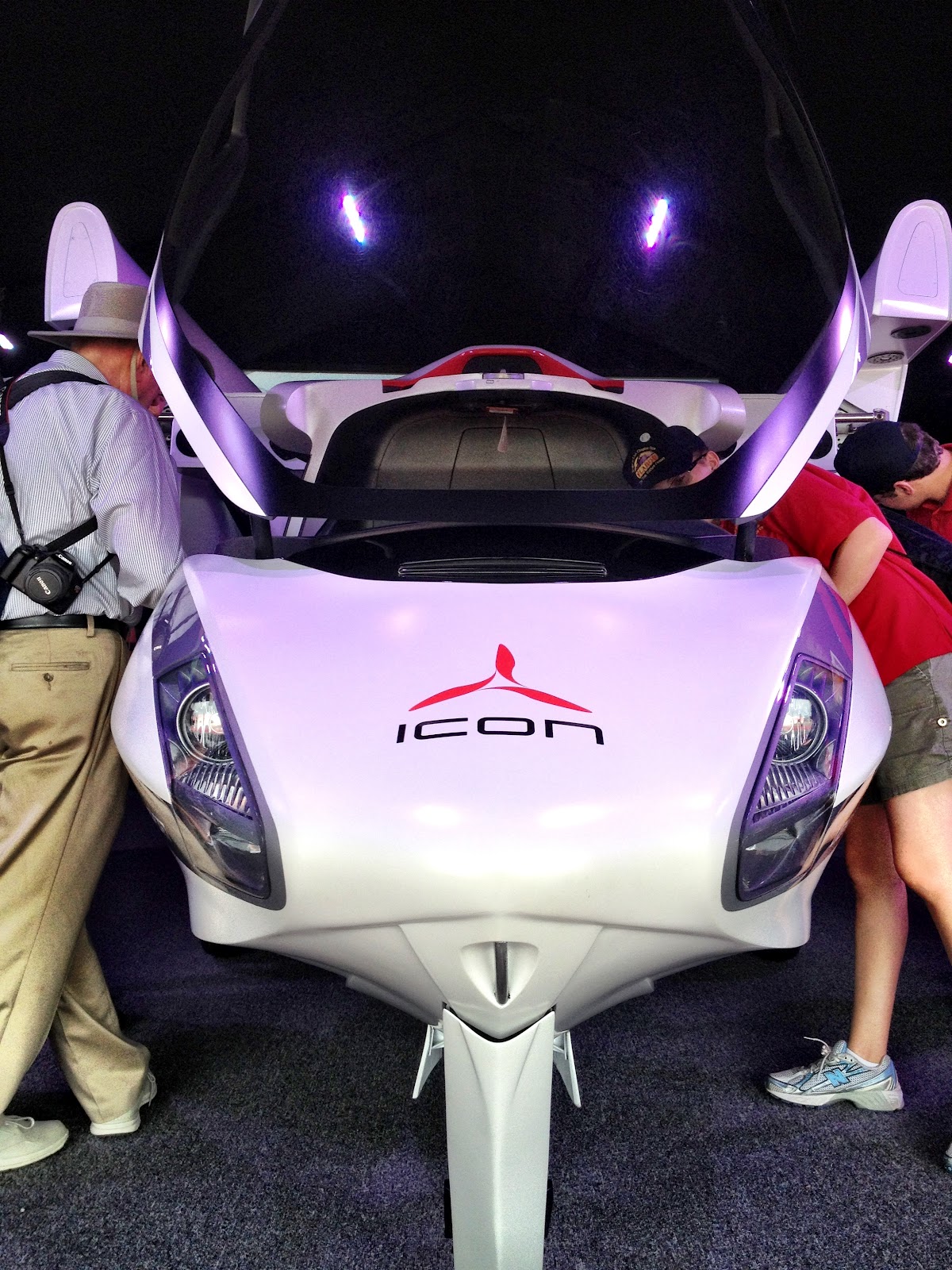
Icon A5 ...an impressive display that definitely caught my attention.  The inside of this tent looked like something straight out of Hollywood.  The Icon has a car-like look to it inside and out.  I would love to have one of these!  Especially after watching the video.


This A-36 Bonanza flew in from Cascavel, Brazil.  A short 34 hour flight.  The picture below was propped up against the nose gear and shows their plotted course. 


A new and inventive use for a chip clip?  


Orbis Flying Eye Hospital.  This was an eye opening experience...please excuse the pun.  I am told that FedEx manages and maintains the aircraft as part of its own fleet and that FedEx and United supply the pilots.  Click the link to read more, but I found this to be a donation worthy organization.  Check it out.


One of my favorite little airplanes, the  Piper J-3 Cub.  I got my tail wheel sign-off in one of these after being told by my father that I couldn't be a real pilot without tail wheel experience.  I couldn't agree more!


This is a picture of my awesome Dad in front of an  OV-1 Mohawk similar to the one he flew in the Vietnam War.  


Wednesday, June 20, 2012

Only in Arkansas


Take a close look at the picture to the left.  Notice anything odd?  No?  It’s there…keep reading.

I was the Captain of an EMB-120 Brasilia in November 1998, the month KXNA, Northwest Arkansas Regional Airport opened to the public.  Piloting a flight from Dallas, Ft. Worth scheduled to arrive well after dark, I noticed a NOTAM (Notice to Airman) that indicated the airport beacon would not be visible when approaching the airport from the southwest.  A lighted, land (as opposed to water) airport beacon is supposed to flash a constant white then green pattern at night or when the airport is experiencing poor weather conditions.  When flying at night in visual flight conditions, the beacon is most commonly used by pilots to identify the location of an airport.

Now familiar with the NOTAM, I was aware that the beacon would not be visible to me as I approached this unfamiliar airport at night for the first time.  Finding the airport…quite literally located out in the middle of nowhere…turned out to be a simple task, but the reason behind the NOTAM made me laugh back then and as I taxied past the XNA control tower earlier this week, I couldn’t help but laugh as I noticed the condition still exists today.

I queried the tower controller about this and got the same answer I got back in 1998, so I can only assume it to be true.  The airport beacon is often located on top of the control tower at small airports or at a significant distance from the control tower at some larger airports.  At KXNA, the beacon is located on a pole…wait for it…right next to the control tower and at the exact same height as the tower controllers.  So at night, or anytime the beacon is in use, the light from the beacon shines directly into the control tower, blinding the controllers as they attempt to perform their duties.  

“Only in Arkansas” the tower controller explained.  His words, not mine.

Clearly this was an unacceptable situation, so let me pose the same question to you that must have been asked of those in charge back then.  What should be done to rectify this design defect?  Move the beacon to another location on the airport.  Put the beacon on top of the control tower.  Put the beacon on a taller pole.  All sound like reasonable solutions to me.  Their solution?  Put a shroud around the beacon to keep it from shining into the control tower.  In their defense, this solution did indeed solve the problem at hand, but it also created the issue that remains today.  The beacon is not visible to pilots arriving from the southwest. 

“Only in Arkansas” the tower controller explained.  His words, not mine.

Tuesday, April 24, 2012

Downsizing


The plight of the average employee at American Airlines over the past ten plus years has been relatively unpleasant, and the bankruptcy process has, to no one’s surprise, failed to yield improvement. Today, even before the pay cuts I know are coming, I find myself unable to afford the house that was easily within my budget 10 years ago.  I’ve decided to downsize my finances and move into a smaller home, a process that has been all consuming during the past month.

Many have forgotten that the employees of this once great airline took huge pay cuts back in 2003 to avoid the very situation in which we are now embroiled. My personal contribution to the "keep American out of bankruptcy" fund included a 23% pay cut on top of a reduction in benefits and a displacement out of my home base for a period of five years. We took those cuts at a time when most of the other carriers were working under fresh new contracts that already put their salaries above ours, so the pay-cuts were especially deep and afforded the company a significant cost advantage over the competition. "Shared pain for shared gain" was the catch phrase we kept hearing from management, but 10 years later those managing the airline are the only ones who have gained financially as the airline has faltered under their leadership. 

Yesterday, as the airline’s legal team was in court arguing to have our contract thrown out the window, I was at my attorney’s office closing on the sale of my house.  As poor as the real estate market is in the US, I have been fortunate. A friend of a friend heard we were considering a move and asked to see the house. We were able to come to terms without the assistance of a realtor, saving me a significant chunk of change.

Moving into a significantly smaller home is never fun and the process of packing up and getting rid of everything that wouldn't fit was a time consuming and mentally exhausting experience.  While my wife and children have been exceptionally supportive, I know the move is hard them.

So while it's been an exciting month, I haven't had time to share my experiences with you. In the last 30 days I landed in El Paso, Texas in winds gusting to almost 50 knots with 1/2 mile visibility in blowing dust. I was lucky to be stuck in a hotel room the day tornadoes tore through the Dallas area...$3500 in damage to my car. The following week I circled west of the Dallas, Ft. Worth area for an hour before thunderstorms forced a divert for fuel and topped of the month with two significant mechanical issues...all stories for another time.

So yes, it's been an exciting month at home and at work. A month now topped off with rumors of a merger between American and US Airways. I would define my position as cautiously optimistic, but find myself on the fence.  The rumors of a merger between the two are nothing new, but they are now fueled with the knowledge that the three major unions at American are not only behind the idea but have successfully agreed to a tentative contract with the management of US Airways.  This is a major accomplishment given almost zero progress in contract negotiations with AMR during the past five years. Not to mention that while AMR is going forward with plans to impose draconian contracts on its labor groups, the US Airways management team is promising pay raises and job protections.

While this is all a significant improvement on what AMR has planned, I’m still unable to throw complete support behind the idea of a merger. There are many reasons for this, but my primary source of concern is simple history. US Airways wants, and arguably needs, American Airlines.  They have attempted and failed to merge with both Delta and United and are convinced that they need a partner to survive long term.  AMR is the last ugly girl at the dance and US Airways is tired of standing with their backs against the wall watching everyone else enjoy the party. I'm convinced they will say and promise whatever is necessary to gain the trust and cooperation of the labor groups at American. This is a serious concern that was clearly demonstrated when American merged with TWA in 2001.

I mentioned before that I was displaced to another base in 2003 after our first near miss with bankruptcy. My displacement resulted in 5 years of commuting to St. Louis, Missouri to fly with the former TWA pilots.  I had a love hate relationship with this pilot group.  They were just another group of pilots shaped by different circumstances than my own…both competent and skilled aviators.  But I also found them to be generally ticked-off about life and the impact the TWA/AA merger had on their careers.  Unfortunately I was often the target of their frustrations.

The merger agreement between the two airlines guaranteed that all Captain positions in St Louis, regardless of seniority, would be flown by former TWA pilots.  So during my five years in STL, I flew exclusively with former TWA pilots and often flew with Captains who were far below me on the American Airlines seniority list.  If I was successful in keeping the subject of conversation off the merger all was good...but I was rarely able to avoid the subject.  Once the subject of conversation veered toward the topic of the merger all bets were off.  I often endured angry tirades and long trips to the "soap box."  I didn't agree with much that was said but didn't feel the cockpit was the right place to get into an all-out argument, so I often kept my opinions to myself.

One thing I often heard from the TWA pilots stuck with me then and remains on my mind now. When the merger between American and TWA was announced, the employees of TWA rejoiced. They thought they had been saved. American wanted TWA and made promises to the employees…many of which they did not keep.  Not unlike the promises of pay raises and job protections that I'm hearing now. The TWA employees didn't fare so well in the years after 9/11 and I'm not sure how the employees of American Airlines will fare when the dust settles on this merger…assuming of course that it occurs at all.

It is what it is and only time will tell. The one thing that I know for sure is that I am simply along for the ride. Hopefully it will be a smooth one...but I wouldn't bet on it.